White-Label Crypto Casino on Sui: Launch a Provably-Fair On-Chain Casino
Launching a white-label crypto casino used to mean renting someone else's platform, bankrolling the house yourself, handing over a slice of every dollar in revenue share, and asking players to trust a random number generator they could never see. That model still dominates the market. It is also the reason most new operators run out of runway before they find product-market fit.
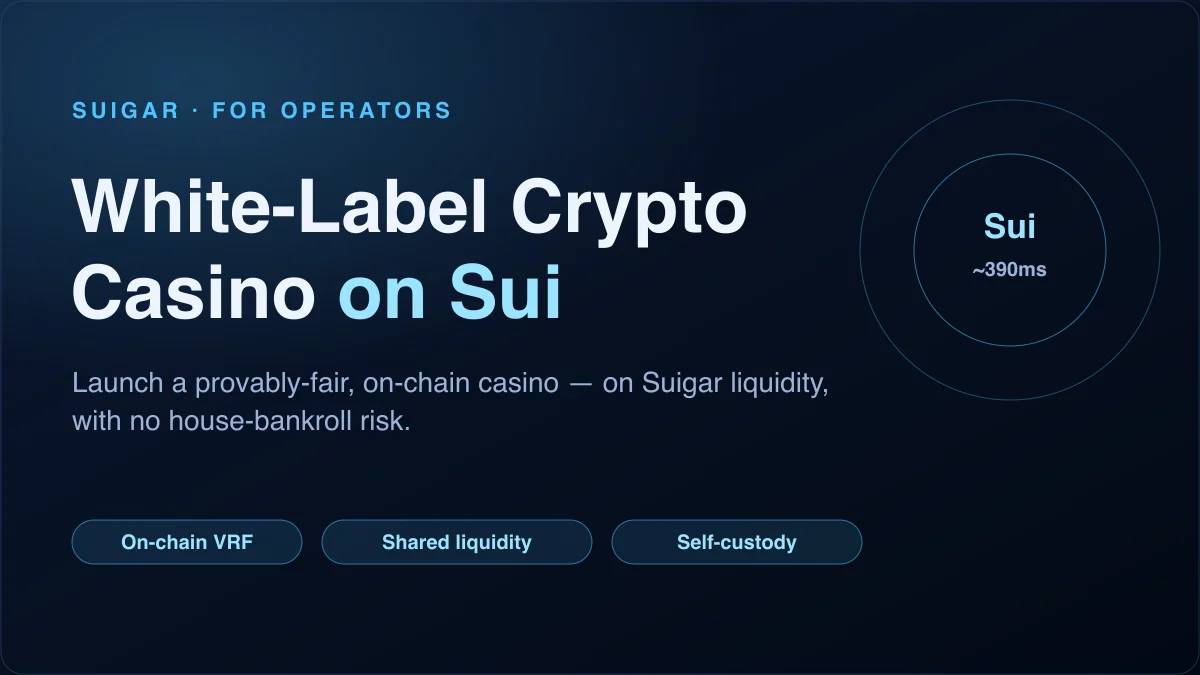
There is a different path. A white-label crypto casino built on-chain changes who carries the risk, where the randomness comes from, and what the operator actually owns. This guide is for founders and operators evaluating that decision. It explains how the traditional model works, what moving on-chain changes, and how a Suigar white-label lets you launch a provably-fair casino on the Sui blockchain without taking house-bankroll risk.
No part of this removes the hard work of acquisition, brand, and retention. What it removes is the structural tax that traditional white-label deals quietly charge, and the trust problem that off-chain casinos can never fully solve.
What a white-label crypto casino actually is
A white-label casino is a ready-made gaming platform that you launch under your own brand. The provider supplies the games, the wallet rails, the back office, and usually the license umbrella. You supply the name, the design, the marketing, and the players. Instead of building a casino from zero, you skin and operate one that already exists.
A crypto white-label is the same idea with digital assets as the rails. Deposits, bets, and withdrawals happen in tokens instead of fiat. The appeal is obvious: faster settlement, global reach, fewer payment processors, and a player base that already lives on-chain. On a chain like Sui, a bet can finalize in roughly 390 ms and cost a fraction of a cent, under $0.01, in gas. The catch is that most crypto white-labels are still traditional casinos wearing a crypto coat. The money moves in tokens, but the randomness, the custody, and the bankroll still sit on a private server.
The traditional white-label model and its hidden tax
In the standard arrangement, the operator is responsible for the house bankroll. When a player wins, the payout comes from your float. A bad variance week can wipe a small operator out before marketing ever pays off. On top of that, the provider takes a revenue share of gross gaming revenue, commonly somewhere around 15-40% of GGR as an industry estimate that varies widely by deal, for as long as you run on their platform.
Then there is custody and fairness. Player funds usually sit in a custodial wallet the operator or provider controls. The random number generator runs off-chain, certified by a lab in the best case and simply asserted in the worst case. Players are asked to trust that nothing was adjusted after they clicked. That is a hard sell to a crypto-native audience that has watched custodial platforms fail.
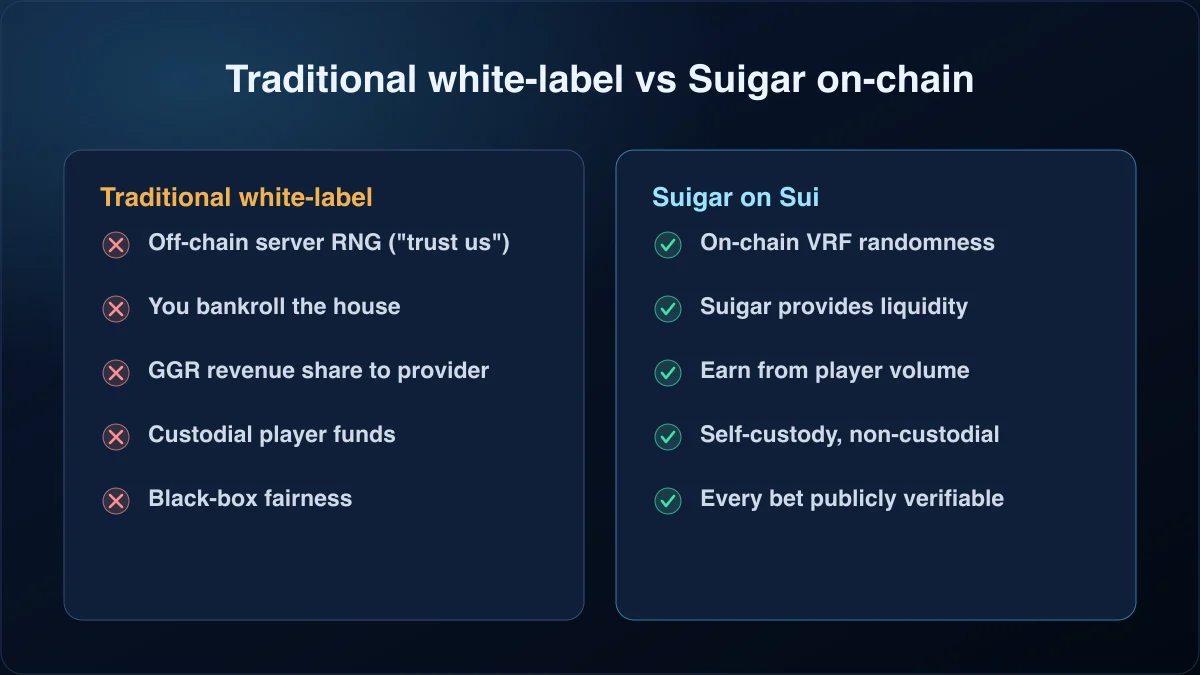
Stack those costs and the picture is clear. The traditional white-label charges you in four places at once: bankroll risk, revenue share, custodial exposure, and a fairness story you cannot prove. The on-chain model is interesting precisely because it attacks all four at the same time, rather than just swapping fiat for tokens.
What "on-chain" actually changes
On-chain means the games, the randomness, and the settlement live on a public blockchain instead of a private database. That is not a cosmetic difference. It moves the three things players worry about most out of the operator's hands and onto a ledger anyone can read.
First, randomness comes from the chain itself. On Suigar, outcomes are generated with on-chain verifiable randomness, and a bet typically settles in around 390 ms, so there is no server seed sitting in a data center that anyone could touch. Second, settlement is public. Every bet and result is recorded on-chain and checkable after the fact. Third, custody can stay with the player. Funds move through smart contracts rather than a platform wallet you have to secure and insure. The same mechanics that make games like provably-fair Plinko verifiable for a single player are what make the whole operator model more honest.
How a Suigar white-label works
Suigar supports a white-label model for selected partners. You build a custom-branded casino experience and integrate directly with Suigar's smart contracts. The games run on top of Suigar liquidity instead of requiring you to bankroll the action alone. You focus on brand, acquisition, and distribution, and you earn from the player volume you bring.
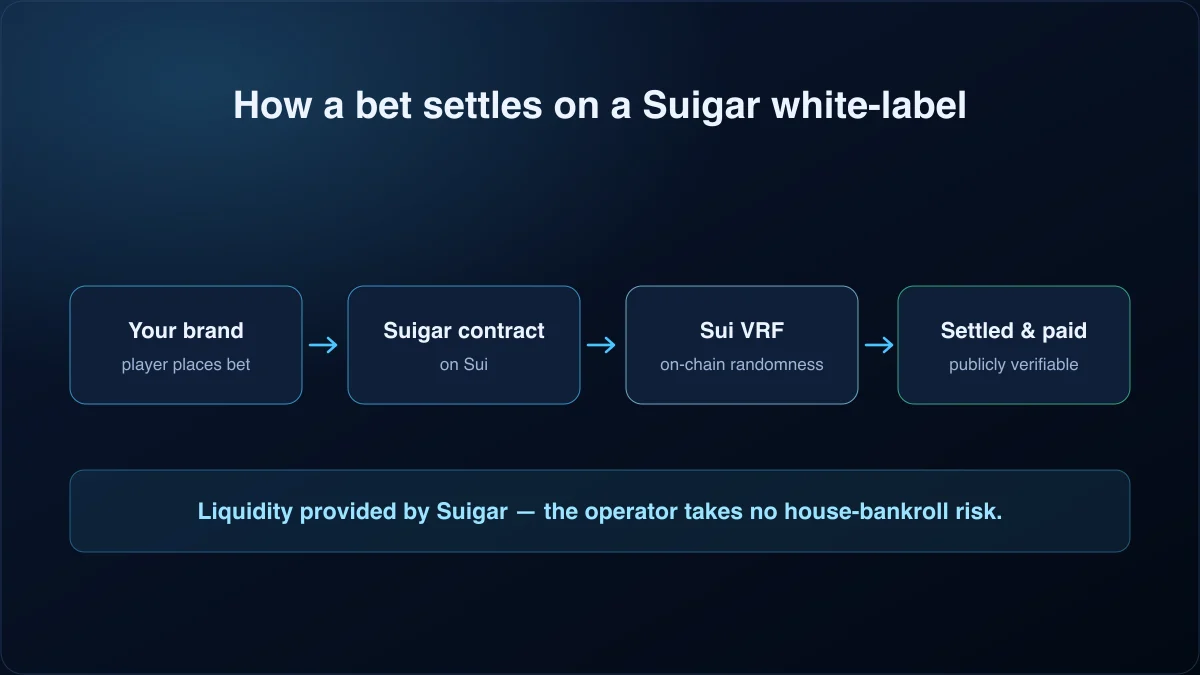
The flow is simple. A player on your branded front end places a bet. The transaction goes to the Suigar smart contract on Sui. Randomness is drawn on-chain, the result settles publicly, and the payout is made from shared liquidity. Because the liquidity and the game rails are provided by Suigar, you do not take house-bankroll risk directly. You can read the exact contract surface and transaction builders in the Suigar SDK and the integration guide.
Partner attribution is handled on-chain as well. When you register as a partner, your wallet address is attached to the transactions your players generate, so the relationship is recorded on the ledger rather than in a dashboard that can change. That is a structural answer to a problem affiliates have complained about for years.
Provably fair, not "trust us"
Provably fair is the part traditional casinos cannot match. In a seed-based system, a casino combines 3 inputs: a hidden server seed, a client seed, and a nonce, hashes them with SHA-256 (a 256-bit hash), then reveals the server seed afterward so you can check the result. That is a real improvement over a black box, but the seed still starts life on the casino's server. Suigar takes it further by drawing randomness from a verifiable random function on Sui itself. The randomness is generated and recorded on-chain, so there is no private seed to trust at all. The concept mirrors how Chainlink VRF brought verifiable randomness to other chains, applied natively on Sui.
For an operator, that is a marketing asset, not just an engineering detail. You can tell players that every result is verifiable and mean it. The contracts behind Suigar games were audited by MoveBit (2025-11-10), which is the kind of third-party signal compliance-conscious partners look for. If you want to feel the player side of this, the breakdown of on-chain Coinflip shows exactly what verifiability looks like in a live game.
Self-custody and the regulatory angle
When players keep custody of their own funds, the operator stops being a honeypot. There is no central pool of customer deposits to hack, freeze, or mismanage. The collapses that defined the last cycle were custodial failures. A non-custodial casino simply does not hold the bag in the same way, which is a genuine trust advantage and, in several jurisdictions, a lighter regulatory footprint.
None of this is legal advice, and licensing still matters. Operators typically still consider a Curaçao, Anjouan, or Malta posture depending on their markets, and you should read a current licensing guide for casino operators before you launch. The point is narrower: transparency and self-custody change the risk conversation in your favor instead of against it.
What you own versus what Suigar provides
A clean way to evaluate any white-label is to draw the line between your job and the provider's job. On a Suigar white-label that line is unusually clear.
- You own: the brand, the front end, the player relationship, acquisition, retention, and the on-chain referral attribution tied to your wallet.
- Suigar provides: the smart-contract game rails, on-chain randomness, public settlement, and the shared liquidity that pays out winners.
- Shared discipline: responsible-gambling practices, jurisdiction rules, and honest marketing remain your obligation as the brand players see.
This split is why the model scales. You are not maintaining a bankroll, a custody system, or an RNG. You are running a growth business on top of infrastructure that is already audited and live.
The game catalog you can launch with
A white-label is only as good as its games. Suigar ships a first-party catalog of 8 games that already run on-chain: Coinflip, Range, Limbo, Plinko, Wheel, Slots, Rock-Paper-Scissors, and PvP Coinflip. Each has its own reference in the docs, such as the Coinflip game reference and the PvP Coinflip reference. Because the games are native rather than aggregated from a third party, the same provably-fair guarantees apply across the whole catalog.
For players, that means familiar mechanics with verifiable results, where the long-run house edge on most games sits in the ~1-5% range (so RTP commonly lands around 95-99%, and edge plus RTP always sum to 100%), varying by game and configuration. For operators, it means you can launch with a complete lineup on day one instead of negotiating game-provider contracts one at a time.
How to launch: a 6-step practical checklist
- Define the brand and market. Decide who you serve, in which languages, and under which jurisdiction posture before you write a line of code.
- Review the integration surface. Read the SDK and integration guide to understand partner registration, transaction building, and event decoding.
- Register as a partner. Configure your partner wallet so on-chain attribution is attached to your players' transactions from the first bet.
- Build the front end. Skin the experience, wire up wallet connection, and integrate the game transaction builders. The business logic already lives in the contracts.
- Settle compliance and responsible gambling. Put age-gating, geo-restrictions, and self-exclusion tooling in place. The brand players see is yours, so the duty of care is yours.
- Launch and acquire. Point your marketing at a casino that can credibly claim provable fairness and self-custody, and let the on-chain proof do the convincing.
Costs and economics: shared liquidity versus revenue share
The economics are where the on-chain model diverges most sharply from the traditional one. In a classic white-label, the two largest line items are the bankroll you must fund and the revenue share you surrender. The first is a capital risk; the second is a permanent haircut on every dollar of gross gaming revenue.
On a shared-liquidity model, the house bankroll is provided by the protocol, so the $0 you put up as a float replaces the six-figure-plus bankroll a traditional white-label expects. Your upside is tied to the player volume you bring rather than to how large a float you can afford to risk, and you skip the ~15-40% GGR revenue share a platform deal typically charges (an estimate that varies widely). That shifts the whole business from a capital game to a distribution game, which is exactly the game most operators are actually good at.
It is worth understanding the macro backdrop here too. On-chain betting, sometimes called GambleFi, is a fast-growing slice of an online gambling market often cited at ~$100B+. Building on rails that are transparent by default is a bet that player trust becomes a durable acquisition advantage, not a nice-to-have.
Common mistakes operators make
- Treating "crypto" as the whole strategy. Accepting tokens is not a moat. Provable fairness and self-custody are. Lead with what players can verify.
- Underestimating retention. On-chain rails lower trust friction, but you still have to earn repeat play with product, support, and rewards.
- Skipping responsible gambling. It is both an ethical baseline and a trust signal search engines and regulators look for on gambling brands.
- Hand-rolling randomness or custody. The entire reason to launch on a provably-fair protocol is to not own those liabilities. Do not rebuild them off-chain.
Frequently asked questions
What is a white-label crypto casino?
It is a ready-made casino platform you launch under your own brand, using crypto as the payment and settlement rails. The provider supplies the games and infrastructure; you supply the brand, marketing, and players.
Do I need to fund the house bankroll on Suigar?
No. On a Suigar white-label, games run on Suigar liquidity, so the protocol provides the bankroll that pays out winners. You do not take house-bankroll risk directly, which is the main structural difference from a traditional white-label.
How is the casino provably fair?
Outcomes are generated with on-chain verifiable randomness on Sui and settled publicly, typically in around 390 ms, so every bet and result can be checked on the ledger. A traditional seed scheme relies on 3 inputs and a SHA-256 hash; here there is no off-chain server seed that anyone has to trust.
Is it non-custodial?
Funds move through smart contracts rather than a platform wallet, so players can keep custody of their assets. That removes the central deposit pool that custodial platforms have to secure.
How long does it take to launch?
Because the 8 games and the settlement already exist on-chain, the build often compresses to weeks rather than the 6+ months a from-scratch casino can take. Most of that time goes into your brand, front end, and compliance, and the exact timeline depends on how custom your experience is.
How do I earn as an operator?
Your earnings are tied to the player volume you bring. Partner attribution is recorded on-chain against your wallet, so the relationship persists even if interfaces change.
Do I still need a gambling license?
Likely yes, depending on your markets. On-chain transparency and self-custody can change your regulatory posture, but you should still take licensing seriously and seek qualified advice.
How do I start a conversation with Suigar?
Read the integration docs to understand the technical surface, then email contact@suigar.com about a white-label or partnership. The docs show exactly what an integration involves before you ever send a message.
The takeaway
A white-label crypto casino does not have to mean bankroll risk, a permanent revenue-share haircut, custodial exposure, and a fairness story you cannot prove. Building on-chain moves randomness, settlement, and custody onto a public ledger, and a shared-liquidity model turns the business from a capital game into a distribution game. That is a better starting position for almost every new operator.
If the pitch you want to make is "provably fair, self-custody, no black box," you need infrastructure that can back the claim. On-chain rails on Sui are built to do exactly that.
Related guides
Suigar publishes a full library of operator guides on launching, running, and proving an on-chain casino. Here is the rest of the collection, grouped by topic.
Provably fair & transparency
- How provably fair casino software works
- Is provably fair gambling actually fair?
- Provably fair vs RNG-certified for operators
- How to verify a casino bet on-chain
- Server seed, client seed, and nonce explained
- On-chain settlement vs RNG audits
- On-chain transparency for casino compliance
- House edge explained for on-chain casinos
Launch & white-label
- Sui casino software for operators
- White-label vs turnkey vs on-chain casino
- A turnkey crypto casino launch checklist
- The fastest way to launch a crypto casino
- How to start an online casino on-chain
- How to build a casino on a blockchain
- Hidden costs of traditional white-label casinos
- Launch a crypto casino without bankroll risk
Costs & economics
- How much it costs to start a crypto casino
- Crypto casino profit margins
- Casino GGR revenue share explained
- The shared-liquidity casino model
Sui & on-chain tech
- Why Sui for iGaming
- Sui vs Ethereum vs Solana for casino apps
- On-chain randomness with Sui VRF
- On-chain casino platform architecture
- How smart contract casinos settle bets
- Integrate provably-fair games with an SDK
- Casino game aggregator vs native on-chain games
Self-custody & compliance
- The non-custodial casino model
- Self-custody casino wallets
- No-KYC crypto casino software
- Crypto casino licensing in 2026
- Do you need a license for an on-chain casino?
Growth & games
- How to get your first 1,000 players
- Player retention in crypto casinos
- Affiliate vs referral vs white-label monetization
- On-chain referral attribution
- The on-chain game catalog for operators
- PvP casino games on-chain
- What is GambleFi?
Sources and further reading
Sui on-chain randomness, Sui documentation.
Verifiable random functions, Chainlink VRF overview.
Smart-contract audits, MoveBit.
On-chain betting market context, GambleFi overview.
Operator licensing, gambling licenses guide.
Gambling involves risk and is intended for adults only. Operators are responsible for compliance, age verification, and responsible-gambling practices in every market they serve.